Aug 02, 2026
August 02, 2026
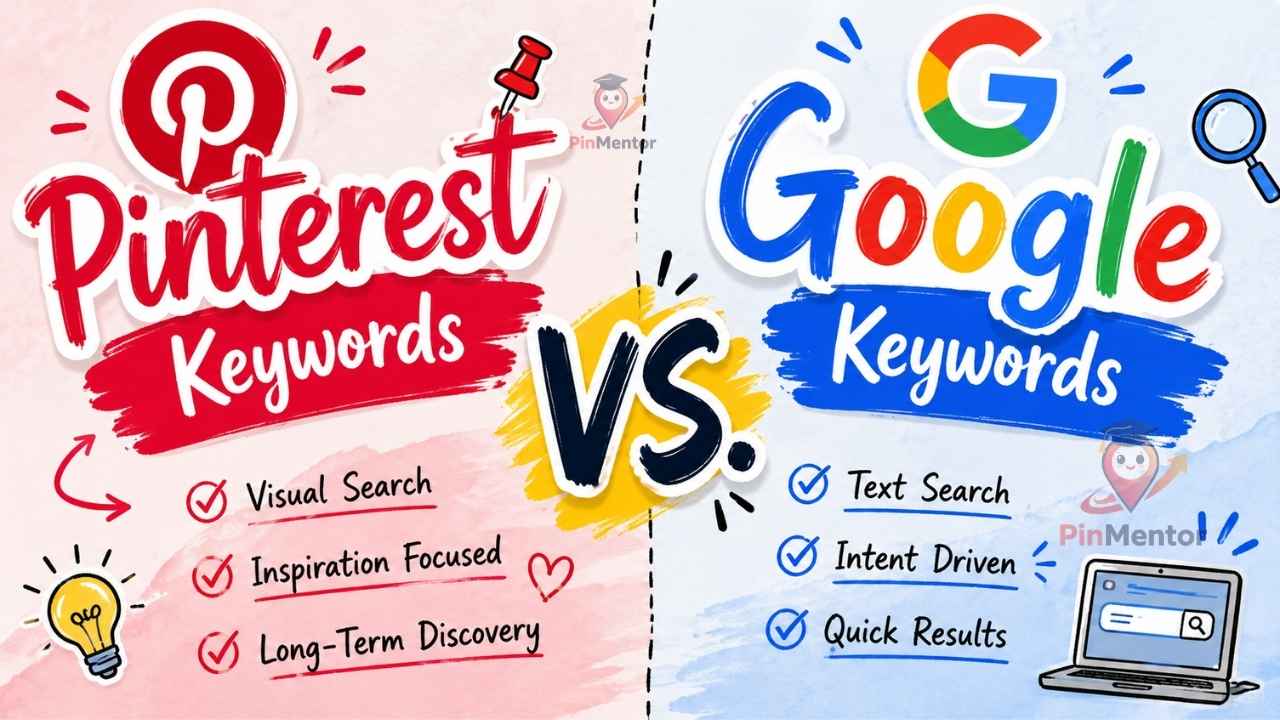
A lot of Pinterest strategy advice boils down to "do keyword research, just like you would for Google." That advice isn't wrong, but it's dangerously incomplete. Pinterest and Google are both search engines — but they're built around different user intent, different ranking signals, and different content formats, which means the keywords that win on one platform often look nothing like the keywords that win on the other.
This guide breaks down exactly where the two overlap, where they diverge, and how to adjust your keyword research process for each — including a full side-by-side comparison table you can bookmark for reference.
If you treat Pinterest keyword research as a copy-paste of your Google SEO work, you'll likely end up targeting phrases that are either too competitive for Pinterest's discovery-driven search, or too narrow for how Pinterest users actually phrase their searches. The result: pins that technically contain "the right keyword" but still don't get found.
Understanding the difference isn't academic — it directly affects which phrases you put in your board titles, pin descriptions, and blog post headlines when you're optimizing for Pinterest traffic specifically.
Google users are often problem-solving or transaction-ready. Someone searching "best budget laptop for college students" usually wants a direct answer or a purchase decision soon.
Pinterest users are often planning, dreaming, or gathering ideas for later. Someone searching "budget laptop setup ideas" or "college dorm desk setup" is browsing inspiration, often weeks or months before acting.
This single difference — answer-seeking vs. idea-gathering — shapes almost everything else about how keywords perform differently across the two platforms, from how long a phrase should be to how far in advance you need to publish it.
Factor | Google Keywords | Pinterest Keywords |
|---|---|---|
User intent | Often transactional or answer-seeking | Mostly inspirational, planning-based, "future me" searches |
Search timing | Close to the moment of need | Often weeks or months before acting |
Keyword phrasing | Shorter, more direct ("best running shoes") | Longer, more descriptive ("cute running shoes outfit ideas for winter") |
Content format rewarded | Text-heavy pages, structured answers | Visual content — images, video, boards |
Ranking factors | Backlinks, page authority, content depth, technical SEO | Pin/board relevance, save rate, engagement, freshness |
Search volume tools | Google Keyword Planner, Ahrefs, SEMrush | Pinterest Trends, Pinterest search autocomplete, Pinterest Ads keyword tool |
Seasonality | Present, but often steadier | Extremely pronounced — many niches spike 45–60 days before a season |
Best keyword length | 2–4 words often sufficient | Longer, more descriptive phrases usually outperform short ones |
Where keywords matter most | Title tags, headers, body copy, meta description | Pin titles, pin descriptions, board titles, board descriptions |
Content lifespan | Can rank for years if authoritative | Can also resurface for months or years, but format freshness plays a bigger role |
It's not all differences. A few principles hold true on both platforms:
Long-tail, specific phrases tend to face less competition than broad, one- or two-word terms — this is true whether you're optimizing a blog post for Google or a pin description for Pinterest.
Search intent should guide your content structure. Just as Google rewards content that actually answers the query, Pinterest rewards pins and boards that deliver on what the description promises.
Fresh, updated content performs better than stale content on both platforms, even if "freshness" means slightly different things (new backlinks and updated dates for Google; new pin designs and consistent publishing for Pinterest).
Keyword placement in the first sentence or headline carries more weight than keywords buried deep in the content, on both platforms.
On Google, "meal prep ideas" might be a reasonably targetable keyword on its own. On Pinterest, that same phrase is often too broad to be useful — you're better off targeting something like "high-protein meal prep ideas for the week" because Pinterest users tend to search with more descriptive, visual-outcome language baked directly into the query.
Google's ranking algorithm is heavily influenced by backlinks — other sites linking to yours as a trust signal. Pinterest has no equivalent concept. A pin's ranking is driven almost entirely by on-platform signals: relevance matching, engagement (saves, clicks, close-ups), and freshness. This means a brand-new account with zero domain authority can rank a pin on page one of Pinterest search in a way that would be nearly impossible on Google without months of link-building.
Google search volume for seasonal terms rises and falls too, but Pinterest users search unusually far in advance — often 45 to 60 days before a holiday or season. Someone searching "Christmas gift ideas" on Pinterest in September isn't unusual; on Google, that same search typically doesn't spike until much closer to the holiday itself. If you're planning content around seasonal keywords, your Pinterest publishing calendar needs to run further ahead of your Google-focused content calendar.
Pinterest can read and index text that appears directly on your pin image (text overlays), which functions as an additional keyword signal Google has no real equivalent for. This means your pin design — not just your written description — is part of your keyword strategy on Pinterest in a way that simply doesn't apply to a Google-optimized blog post.
Google Keyword Planner and tools like Ahrefs or SEMrush pull data from Google's own search index. None of that data reliably applies to Pinterest, because Pinterest doesn't share search volume the way Google does, and its user base searches differently. For Pinterest-specific research, you need Pinterest-native tools:
Pinterest's own search bar autocomplete — type a seed phrase and see what Pinterest suggests, which reflects real, current search behavior on the platform
Pinterest Trends (trends.pinterest.com) — a free tool showing what's rising, seasonal patterns, and related terms
The "related searches" bubbles at the top of Pinterest search results pages — often an overlooked goldmine for long-tail variations
Pinterest Ads Keyword tool — originally built for advertisers, but useful for gauging relative keyword popularity even if you're not running ads
Start with a seed keyword related to your content — something broad, like "home organization."
Type it into Pinterest's search bar and note the autocomplete suggestions that appear. These reflect real, current searches.
Scroll to the related search bubbles above the results grid and click through a few to uncover more specific long-tail variations.
Cross-check trending patterns in Pinterest Trends to see if the term (or a variation) is rising, seasonal, or declining.
Choose 2–3 final phrases — one primary, one or two secondary — and weave them naturally into your board title, board description, pin title, and pin description.
Repeat separately for Google, if the same piece of content is also being optimized for your blog's organic search traffic — don't assume the winning Pinterest phrase will also be the winning Google phrase.
Using short, broad keywords on Pinterest because they worked for a blog post's Google SEO, when longer, more descriptive phrasing would perform better.
Ignoring Pinterest Trends' seasonal timing and publishing seasonal pins on the same schedule as seasonal blog content, missing Pinterest's much earlier search spike.
Assuming a keyword with no Google search volume has no Pinterest value, when the reverse can easily be true — some phrases are essentially Pinterest-only search behavior.
Skipping text overlays on pin images, missing an entire keyword-signal channel that has no direct Google equivalent.
Using identical meta descriptions and pin descriptions, missing the chance to tailor language to each platform's distinct user intent.
Can I use the same keyword research for both my blog and my Pinterest pins? Partially. Your core topic can stay the same, but the specific phrasing usually needs adjusting — Pinterest tends to reward longer, more descriptive phrases than what performs best in a Google title tag or header.
Does Pinterest have an equivalent to Google's Keyword Planner? Not exactly, but Pinterest Trends and the platform's own search autocomplete serve a similar purpose, showing real search behavior and seasonal patterns specific to Pinterest users.
Why does a keyword with high Google search volume sometimes perform poorly on Pinterest? Because search intent differs. A high-volume Google keyword might reflect transactional or answer-seeking behavior that simply doesn't map onto how Pinterest users browse and save inspirational content.
Do backlinks affect Pinterest pin rankings the way they affect Google rankings? No. Pinterest's ranking is driven by on-platform engagement and relevance signals — saves, clicks, freshness, and board/pin context — not by external links pointing to your website.
How far in advance should I plan seasonal Pinterest content compared to Google-focused content? As a general guideline, aim to publish seasonal Pinterest pins 45–60 days ahead of the season, noticeably earlier than you'd typically time seasonal blog content for Google.
Pinterest and Google are both search engines, but they're answering fundamentally different questions for their users — "what should I do right now" versus "what should I plan for later." Copying a Google keyword strategy directly onto Pinterest, or vice versa, means optimizing for the wrong intent on at least one of the two platforms.
Treat Pinterest keyword research as its own discipline: longer phrases, Pinterest-native tools, earlier seasonal timing, and attention to visual text — not just written descriptions.
Keeping Pinterest-specific keywords organized across dozens of pins and boards gets messy fast. PinMentor helps you plan and schedule content around the phrases that actually perform on Pinterest, without duplicating your Google SEO workflow. Start your free 30-day trial →

PinMentor helps you analyze, optimize, and scale your Pinterest strategy with powerful analytics and insights.


@ PinMentor LLC. All Rights Reserved